
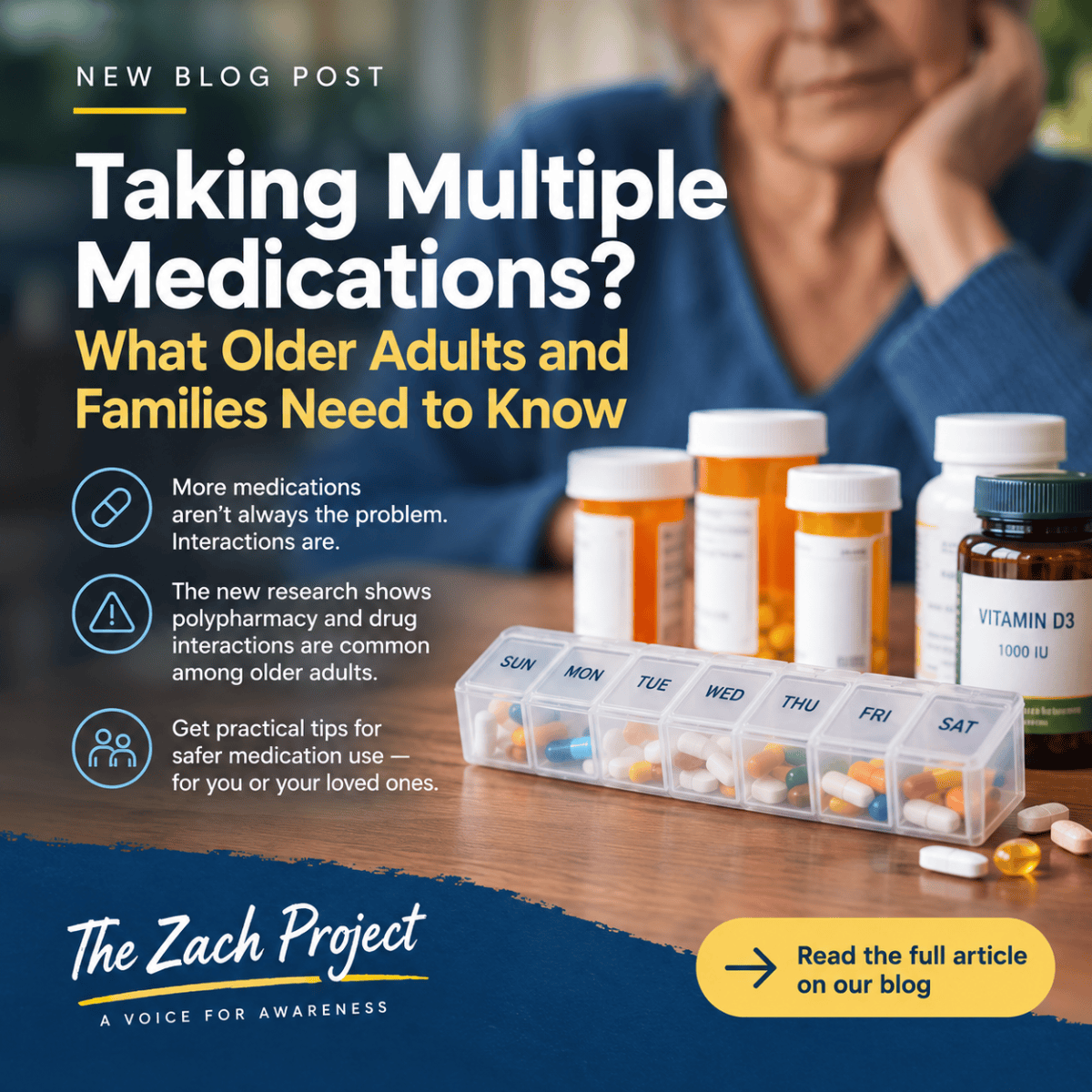
For many older adults, taking several medications every day is simply part of life.
A medication for blood pressure. Another for cholesterol. Something for pain. Perhaps an antidepressant, a blood thinner, a medication for diabetes — and maybe a few over-the-counter medications or dietary supplements as well.
Each medication may have a legitimate reason for being there.
But when several medications are taken together, something else can happen: they can interact with one another.
A new study published in JAMA on September 24, 2026, highlights just how common this issue has become among older adults in the United States. Researchers found that more than one-third of older adults were taking five or more prescription medications at the same time, while more than one in five were potentially exposed to a major drug-drug interaction.
What is polypharmacy?
“Polypharmacy” generally refers to taking multiple medications at the same time. In this study, researchers defined prescription polypharmacy as taking five or more prescription medications concurrently.
That doesn’t necessarily mean someone is taking medications they don’t need.
For an older adult managing several chronic conditions, taking five or more medications may be appropriate and medically necessary.
The concern is that every additional medication creates another opportunity for side effects, interactions or complications.
And prescriptions aren’t the only medications that matter.
Over-the-counter medications and dietary supplements can also interact with prescription drugs.
A person might think of a vitamin, herbal supplement or common pain reliever as relatively harmless. But “over the counter” does not mean “unable to interact with other medications.”
The numbers are changing
Researchers compared medication use among older U.S. adults in 2015–2016 with use in 2021–2023.
They found that prescription polypharmacy increased from 31% to 35.7%.
Dietary supplement polypharmacy also increased, from 12.6% to 16.7%.
At the same time, the percentage of older adults taking drug combinations with potentially major interactions declined somewhat — from 25.7% to 22.3%.
That decline is encouraging, but the number remains significant.
More than one in five older adults in the 2021–2023 data were potentially exposed to at least one major drug-drug interaction.
In other words, even though the prevalence of potentially interacting regimens decreased, medication interactions remain a significant medication-safety concern.
Why drug interactions matter
A drug-drug interaction occurs when one medication changes the effect of another.
Sometimes the interaction can make a medication less effective.
In other cases, it can increase the risk of side effects or serious medical problems.
The researchers point specifically to antidepressants as an area that deserves attention.
Antidepressants were commonly involved in potentially interacting medication combinations. Some combinations can increase the risk of serotonin syndrome, while others can increase the risk of QT prolongation and potentially dangerous heart-rhythm problems.
The study also found that statins and antiplatelet therapies were among the medication classes commonly involved in potentially major interactions.
It’s not just about prescriptions
One of the easiest things for families to overlook is everything being taken outside of a doctor’s prescription.
Someone may have medications prescribed by a primary-care physician, another prescribed by a specialist, and perhaps another by a different provider.
Then there may be aspirin, ibuprofen, acetaminophen, allergy medication, sleep aids or other OTC products.
Add vitamins, minerals or herbal supplements to the list.
Unless someone is looking at the complete picture, it can be surprisingly difficult to know exactly how all of these substances interact.
This is especially important when several doctors are involved in a person’s care.
Each physician may have a good reason for prescribing a particular medication. The potential problem can emerge from the combination.
The danger of assuming “more” is better
For someone dealing with multiple health conditions, taking multiple medications isn’t necessarily a bad thing.
The goal isn’t simply to reduce the number of medications someone takes.
The goal is to make sure every medication has a purpose, that the benefits outweigh the risks, and that the entire medication list is regularly reviewed.
The medical process of evaluating whether certain medications can safely be reduced or stopped is sometimes called “deprescribing.”
The JAMA researchers specifically point to deprescribing efforts and medication-safety guidelines as ways to reduce potentially harmful polypharmacy and drug interactions.
What can families do?
A medication review can be a simple but important step.
Keep an up-to-date list of everything being taken, including:
- Prescription medications
- Over-the-counter medications
- Vitamins
- Herbal products
- Dietary supplements
- Medications taken only occasionally
Bring that list to medical appointments and make sure every healthcare provider involved in someone’s care has an accurate picture.
It can also be helpful to ask questions such as:
“Do I still need all of these medications?”
“Could any of these medications interact with each other?”
“Are any of my over-the-counter medications or supplements a concern?”
“Is there anything I should stop taking?”
Those decisions should be made with a healthcare professional rather than by simply stopping a medication on your own.
One more reminder about medication safety
The growing number of medications available today has provided enormous benefits for older adults.
Medications can control blood pressure, prevent strokes, manage diabetes, treat depression, reduce pain and help people live longer and healthier lives.
The issue isn’t that medications are bad.
It’s that medications are powerful — and their effects don’t always exist independently of one another.
As the number of medications increases, keeping track of how those medications work together becomes increasingly important.
For older adults and the people who care about them, a current medication list and regular medication review can be an important part of staying safe.
Because sometimes the most important question isn’t simply:
“What medication are you taking?”
It’s: “What are you taking with it?”
Source: Qato DM, Wilder J, Ondanat Veetil SK, et al. “Polypharmacy and Drug-Drug Interactions Among Older Adults.” JAMA. Published online September 24, 2026.