
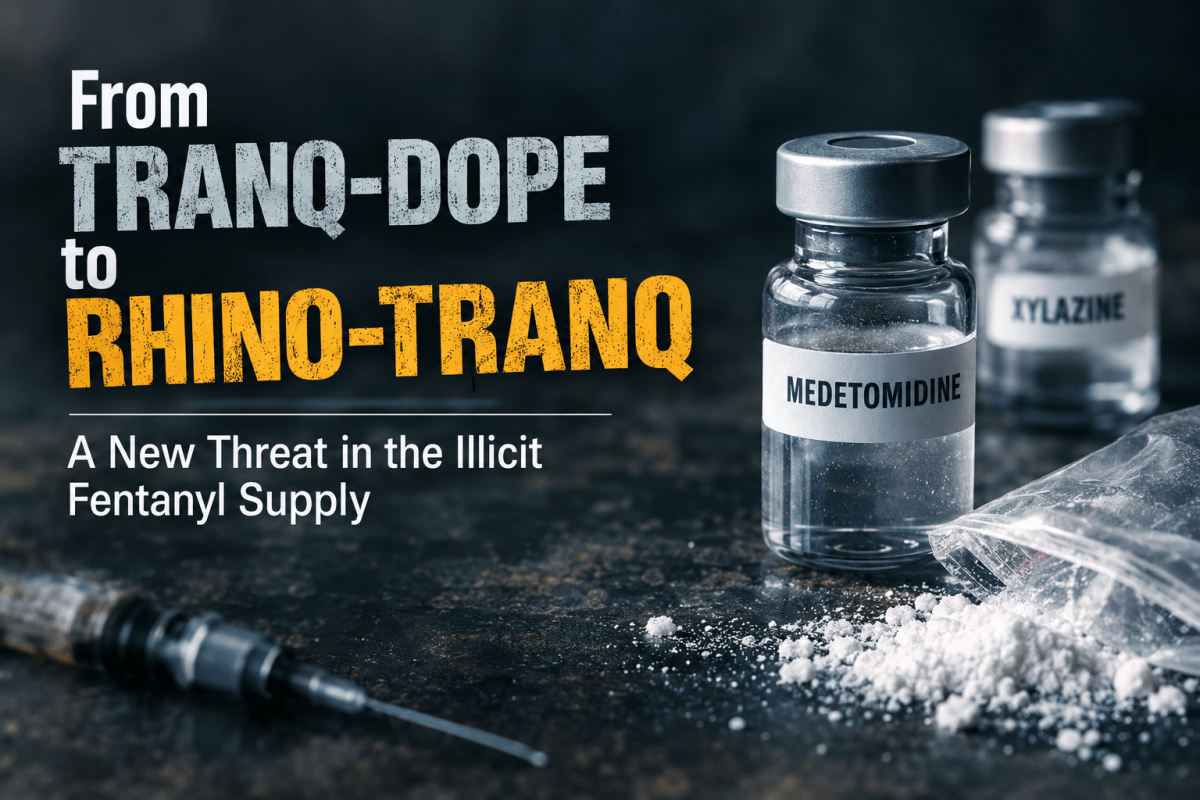
From “Tranq-Dope” to “Rhino-Tranq”: A New Threat in the Illicit Fentanyl Supply
For the past several years, many people have heard the term “tranq-dope,” referring to illicit drugs containing fentanyl mixed with xylazine, a veterinary sedative that has become increasingly common in the illicit drug supply.
Now, another veterinary sedative is emerging.
It is called medetomidine, and toxicologists are increasingly finding it mixed with illicit fentanyl and other drugs. Some are calling this new combination “rhino-tranq.”
The change is important because medetomidine can produce profound sedation, a dangerously slow heart rate and low blood pressure. Its effects can also last longer than those of xylazine, creating additional challenges for emergency responders, hospitals, people who use drugs and their families.
And once again, the illicit drug supply is changing faster than many people realize.
What is medetomidine?
Medetomidine is an alpha-2 agonist, meaning it belongs to a class of drugs that depress the central nervous system.
It is chemically related to xylazine. Racemic medetomidine is widely used in veterinary medicine, while dexmedetomidine, one of its two forms, is also an approved medication used in human hospitals.
Medetomidine itself is not an opioid.
That distinction matters.
When someone overdoses on fentanyl, naloxone can reverse the opioid component of the overdose. But naloxone does not reverse the sedation caused by medetomidine.
This can make an overdose involving both fentanyl and medetomidine particularly difficult to manage.
A person may receive naloxone and have the opioid effects reversed, while still remaining deeply sedated because of the medetomidine.
From “tranq-dope” to “rhino-tranq”
Xylazine has become increasingly associated with illicit fentanyl, particularly in what has commonly been called “tranq-dope.”
But access to xylazine has come under increasing scrutiny and regulation.
Medetomidine appears to be emerging, at least in part, as an alternative adulterant.
It was first reported in the illicit drug supply in Maryland in 2022. Since then, reports have emerged from Philadelphia, Chicago, Pittsburgh and New York City, as well as other parts of the United States.
The term “rhino-tranq” has begun to appear because racemic medetomidine is widely used in veterinary medicine.
But this isn’t simply xylazine being replaced by another drug.
Researchers describe the illicit drug supply as increasingly complex, with fentanyl, xylazine, medetomidine and other substances appearing in different combinations.
In some cases, all three — fentanyl, xylazine and medetomidine — have been detected together.
The shift is not a clean break.
It is another layer of uncertainty.
What are the effects?
Medetomidine can cause:
- Extreme sedation
- Muscle relaxation
- A dangerously slow heart rate (bradycardia)
- Low blood pressure (hypotension)
- Prolonged unconsciousness
Researchers have also reported serious withdrawal symptoms among people exposed to medetomidine through the illicit opioid supply.
One reason for concern is that medetomidine can have a longer duration of action than xylazine. This may help explain the profound sedation and slow heart rates observed in some non-fatal overdoses.
The combination of opioids and powerful non-opioid sedatives creates an especially difficult situation.
Someone can be experiencing a life-threatening opioid overdose while also being affected by a sedative that naloxone cannot reverse.
What researchers are finding
A recent analysis from NMS Labs and the Center for Forensic Science Research & Education looked at hundreds of blood samples in which medetomidine or dexmedetomidine was detected.
In one group of 244 blood samples, fentanyl and/or norfentanyl was present in 78% of cases.
Para-fluorofentanyl accounted for another 14% of cases where fentanyl or norfentanyl was not reported.
Other substances, including cocaine and methamphetamine, were also found in some samples.
The findings reinforce a troubling reality: there is no longer a single “street drug” to be concerned about. The illicit supply can contain multiple powerful substances, sometimes without the person using the drug knowing what is actually present.
In a separate case series involving 100 specimens from non-fatal and fatal overdoses, fentanyl was detected in 93% of cases and xylazine in 76%.
Medetomidine was present alongside these substances in many of the cases.
The researchers also found significant variation in the concentrations of both fentanyl and medetomidine.
That variability is itself a danger.
The drug supply keeps changing
Perhaps the most important message is that the illicit drug supply is not static.
As one substance receives greater attention or becomes more difficult to obtain, another can take its place.
Medetomidine is now being detected not only in biological specimens from overdose cases, but also in law-enforcement seizures, drug-checking programs, wastewater and drug paraphernalia.
Although early reports were concentrated in the Northeast, medetomidine has now been identified in multiple states.
Researchers are seeing evidence of a gradual decline in fentanyl/xylazine combinations alongside an increase in fentanyl/medetomidine combinations during 2025 and the first quarter of 2026.
But again, this doesn’t mean xylazine has disappeared.
In some samples, fentanyl, xylazine and medetomidine were all present together.
The illicit drug market is becoming more complicated, not less.
What does this mean for families?
For families who have already experienced the devastating effects of substance use disorder, developments like this can be frightening.
Many parents and loved ones understandably assume that if they can learn enough about a particular drug — fentanyl, heroin, xylazine or another substance — they can understand the risk.
But today’s illicit drug supply makes that increasingly difficult.
A person may believe they are purchasing one substance and instead receive a mixture containing fentanyl, medetomidine, xylazine or other unexpected drugs.
Even experienced users may not know what they are taking.
And because medetomidine is not an opioid, naloxone cannot reverse all of its effects.
That does not make naloxone unimportant. Quite the opposite: if an opioid such as fentanyl is involved, naloxone can still be lifesaving.
But the emergence of medetomidine is another reminder that an overdose can involve more than one drug and that the effects may be more complicated than they appear.
The warning we cannot ignore
The story of medetomidine is still developing.
Researchers and public-health officials are continuing to monitor where it appears, how frequently it is being found, how it affects people who use drugs and what role it may play in overdoses and withdrawal.
But we already know enough to take the warning seriously.
“Tranq-dope” was once a relatively unfamiliar term.
Now xylazine is widely recognized as a serious threat within the illicit fentanyl supply.
Medetomidine may be following a similar path.
The name may change from “tranq-dope” to “rhino-tranq,” but the underlying problem remains the same: an unpredictable and increasingly dangerous illicit drug supply.
For families and communities affected by substance use disorder, awareness matters.
Because the drugs on the street today may not be the drugs we were talking about yesterday.
And tomorrow, there may be something else.
Sources: NMS Labs; Center for Forensic Science Research & Education; Journal of Forensic Science; NEJM Evidence; Clinical Toxicology; Journal of Addiction Medicine; Journal of Analytical Toxicology; Social Science & Medicine.